First, check whether your card shows a pending hold or a completed payment. Then compare it with the final rental bill. A deposit still reserved on your card needs a different conversation from a damage charge that has already been taken.[6]
Ask the rental company for an itemised explanation and put the part you dispute in writing. Include the booking reference, the amount, what happened and what you want corrected. If the problem concerns a booking website’s payment, cancellation or promises, contact that business too.[1][2]
Still at Dublin Airport? Ask for the reason for any refused collection or extra charge before leaving the desk. Already home? Your agreement, photos, card record and emails will help you explain the problem without another counter visit.
Choose the problem that matches yours
| Your problem | What to check | What to do next |
|---|---|---|
| Your deposit still appears on the card | Does the issuer say it is pending, completed or reversed? Is any part a separate fuel payment? | Ask the company for its release or refund record, and ask the issuer what remains outstanding. There is no single release time for every rental. |
| Money was taken after return | The final bill, transaction date, currency and exact charge description | Ask the business that took it for the agreed term and calculation. Dispute the particular entry, not just the total bill. |
| Damage was reported after you left | Collection and return photos, condition reports and inspection time | Request the damage evidence and an explanation linking it to your rental. Ask how each amount was calculated. |
| You paid for protection but were asked for more | Was it the supplier’s waiver, separate excess insurance or a card benefit? | Ask what the extra product changes and why it is being required for your booking. Check your own policy before assuming it replaces the supplier’s requirements. |
| Your card was refused | The named driver, cardholder, card type, available funds and collection documents | Request the exact reason in writing. Contact the booking platform while you are still at the counter where its terms require this. |
| Fuel, cleaning, toll or administration charges look wrong | The accepted fuel option, return evidence, relevant fee clause and any toll record | Ask for the individual charge and supporting record. A toll and a rental company’s administration charge are different items. |
| You were charged for a late return | Agreed return time and place, any approved extension, key-return time and check-in record | Send your time evidence and ask the company to explain the difference. Do not assume another provider’s grace period applies. |
| Your flight was delayed, or the car was unavailable | The collection deadline, cancellation terms, messages sent and the reason no car was supplied | Distinguish a late arrival from a supplier failure. Contact the supplier and relevant broker promptly and ask what options remain. |
| A refund was promised but has not appeared | The promised amount, date, payment method and actual card credits | Ask for confirmation that the refund was processed, not just approved, and a reference your issuer can use. |
These checks follow the distinction between the payment record, the rental agreement and the booking platform’s terms. The result still depends on your documents.[1][6][5][7]
Still at Dublin Airport: what to do before you leave
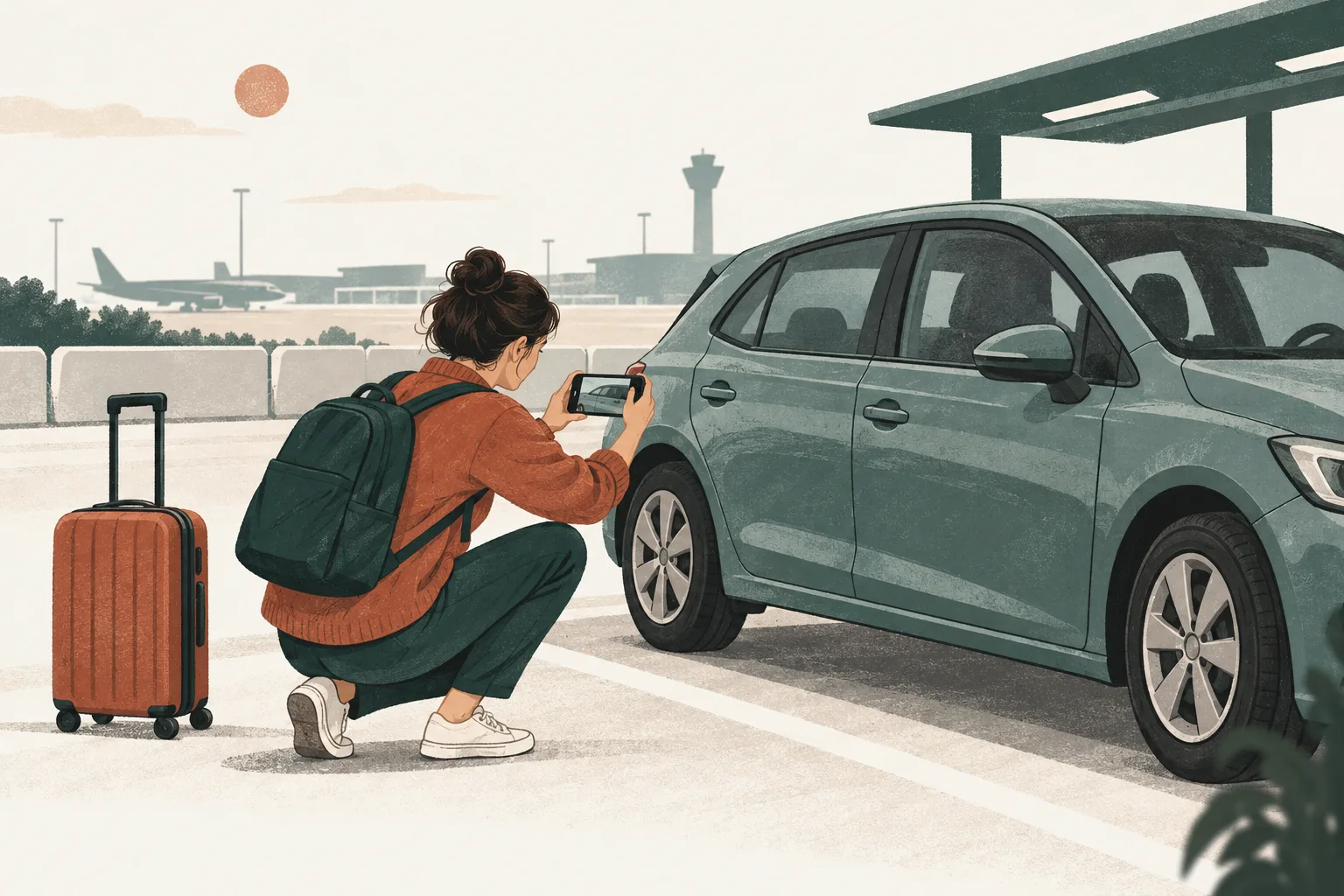
Photograph the car, fuel gauge and mileage. Keep the return time, location and any inspection record together.
IllustrationCheck which desk and return location your booking uses
An arrivals desk, the car collection facility and an off-airport office are not necessarily the same place. Enterprise, for example, identifies desks in both terminals and an Eastlands car-hire facility. Easirent describes an off-airport office with an airport shuttle.[8][9]
Dublin Airport describes car-rental desks in the arrivals halls of Terminal 1 and Terminal 2. Check your booking for the desk, collection point and return location used by your rental company.[10]
The airport website’s booking platform is a separate point: it books with Europcar, rather than making daa your rental company. Its FAQ sends those booking queries to Europcar.[10][11]
If the company will not give you the car
Ask: “What exact requirement does my booking not meet?” It might concern the driver, card, documents, arrival time or vehicle availability. Those are different problems.
Keep the refusal time and the explanation. Ask what alternatives are available and what they would cost. Do not describe a supplier’s inability to provide a car as your voluntary cancellation unless that is what happened. For a broker booking, contact its support while you are at the counter, rather than assuming the desk can change or refund the broker’s payment. Booking.com’s car terms specifically make counter contact important in some refusal situations.[5]
If you need another car urgently, keep the replacement quote and receipt. Having those records does not guarantee reimbursement of the extra expense.
If you are asked to pay more
Ask for a breakdown before agreeing: rental price, optional cover, fuel, additional driver, location service and any other item. Ask which parts are required for your booked rate and which are optional. Keep the written quote and a copy of what you sign.[1]
Before driving away, photograph the car and have unrecorded damage added to the condition report. Check the fuel level and mileage. If the car is not in an acceptable condition, raise that with the company before using it.[1]
If you are returning the car
Use the agreed return location and key procedure. Keep photos of the outside and inside, the fuel gauge, mileage and where you parked. Ask for an inspection and a copy of the return record.[1]
If nobody is available to inspect it, record when and where you returned it and send a short written confirmation to the company. Ask when the inspection will take place. Do not assume dropping keys into a box automatically ends every responsibility: the applicable return terms and evidence still matter.[7]
Already home: put the records in order
Start with the disputed card entry, not the whole holiday. Ask your issuer whether it is still a hold or is a completed payment. Match the amount and currency to the final invoice and any separate fuel or damage bill.[6]
Write a short timeline: booking, collection, return, disputed charge, first complaint and latest reply. State the result you are asking for, such as an explanation, removal of an incorrect fee, release of a hold or refund of a specified payment.[2]
Ask your card issuer promptly about any applicable dispute deadline. Check an excess-insurance policy’s notification and document requirements separately. Neither a letter to the rental company nor a request for help from TBD should be treated as stopping another deadline.[3][24]
Keep promised refunds separate from money you can actually see credited. If money is returned while a bank or insurance claim is open, tell that provider what has changed. Do not seek payment twice for the same loss.
The evidence to keep together
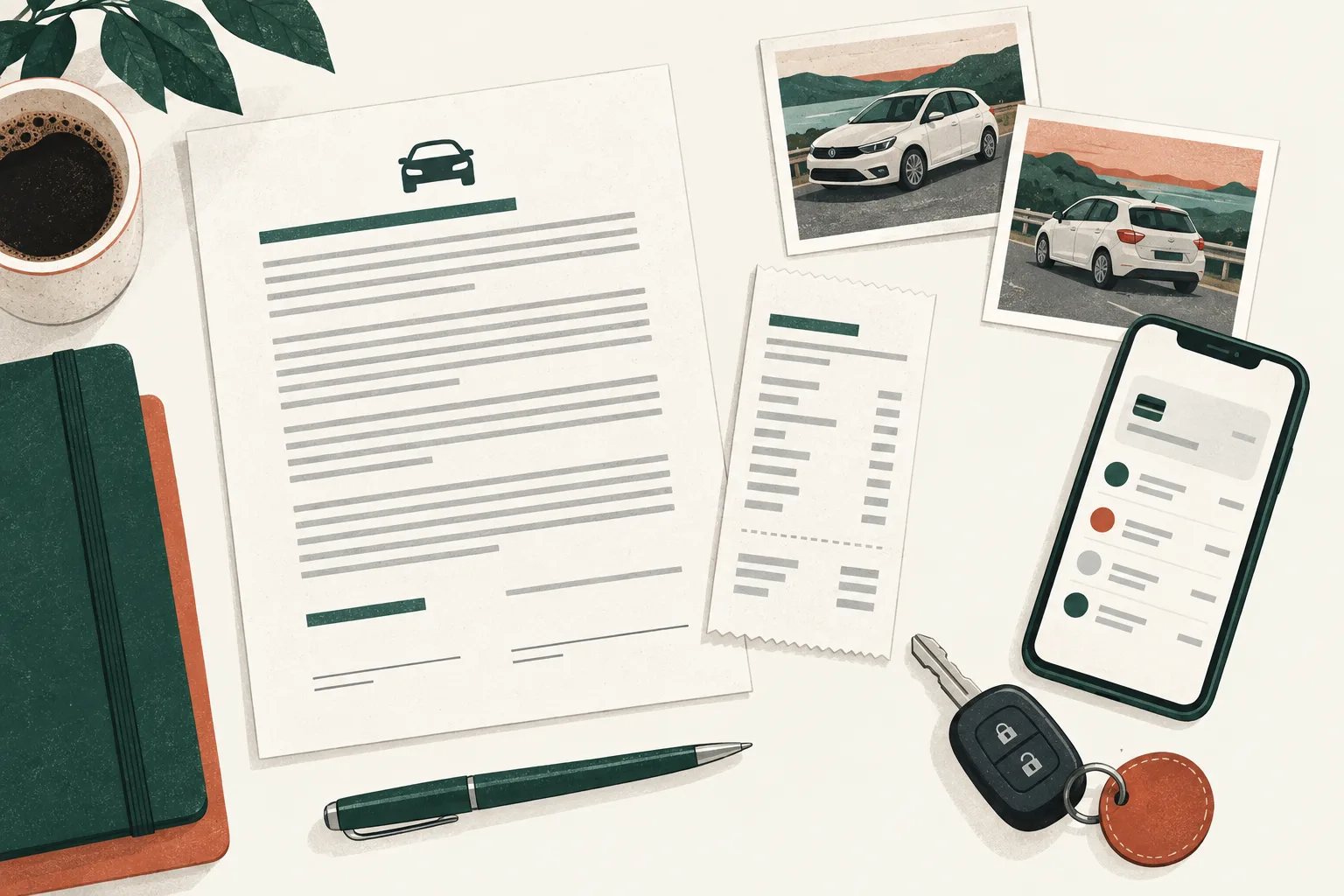
Match your booking and agreement to the bill, photos and card entry. Share relevant copies and keep the originals.
IllustrationYou do not need a long account of every conversation. The following records are more useful:
- Your booking: confirmation, voucher, quoted inclusions, collection requirements and booking-date terms. Include both the broker reference and rental reference where there are two.
- Your agreement: the signed rental contract, supplier’s legal name, cover selected, fuel option and authorised extras.
- The car records: original collection and return photos, condition reports, fuel, mileage, return location and key-return instructions.
- The money records: the itemised bill, disputed entry, its pending or completed status, and any actual refund credit. Remove unrelated transactions and unnecessary card details from copies.
- Anything specific to the problem: a fuel receipt, toll passage record, flight-delay notice, approved extension or written refusal to supply the car.
- Your correspondence: the complaint, replies, dates, promised adjustments and the remedy still outstanding.
Keep the original files. Send relevant copies rather than passwords, full payment-card details or identity documents you have not been asked to provide.[1][2][23]
Not sure what to say to the rental company? Use TBD’s complaint-message tool to put the dates, charges and a list of your evidence into a draft you can check and send.[22]
What the common charges actually mean
A card hold is not the same as a refund due
A pre-authorisation reserves funds or available credit. It may look like a payment in your banking app even though it has not become a completed charge. Ask the issuer to confirm its status. Ask the rental company whether it has released the authorisation or instead processed a charge or refund.[6]
Fictional example: Your app shows €1,200 against a completed rental. Your issuer confirms it is still a pending authorisation, and the company provides its release record. The next question is why the funds remain reserved, not why there is no separate €1,200 refund credit. If the issuer instead confirms a completed charge, request the bill and challenge any unsupported amount.
“I bought insurance” can describe different products
Basic third-party cover concerns injury or damage to other people and their property. A supplier’s damage waiver deals with specified liability for its vehicle. A separate excess policy commonly reimburses an eligible payment after you have paid the rental company. Card collision cover has its own eligibility and proof requirements.[1][4][12]
Check the product name and policy, not just a booking-page label such as “full protection”. A separate policy does not itself prove you can avoid a deposit, use somebody else’s card or ignore the supplier’s collection rules.[12][5]
Damage after return: ask for evidence, not assurances
Request the collection and return condition reports, dated photographs, inspection time, description of the damage, relevant contract term and calculation. Ask for a repair invoice or estimate where relevant, while checking what each part of the charge represents. If the car was inspected later, ask how the company has distinguished your rental from any later movement or handling.
A missing joint inspection can leave an evidence gap, but it does not automatically cancel a claim. Equally, a damage report is something you can question, not proof that every amount is correct. The company may claim items beyond a completed repair invoice, so ask what each amount represents.[1][7]
For a longer worked example, read how to request evidence after a car-hire damage charge.
Fuel, cleaning, tolls and late returns
A refundable fuel payment is different from choosing to buy a tank at collection. Some fuel-purchase options do not refund fuel left in the tank. Check the option recorded on your agreement before relying on a full-return photo alone.[7]
For cleaning, ask what was beyond ordinary cleaning and request the supporting photos and fee basis. For a late-return charge, ask which time and location the company recorded and compare these with your own records.[7]
For an M50 charge, check the vehicle registration, passage date and whether your rental company handles payment. eFlow says that where you are responsible for paying, the deadline is 8pm the following day. Do not pay the same passage again without checking whether the company has already handled it. A dispute about an administration charge is not a reason to assume a toll deadline has stopped.[14]
Cancellation, a delayed flight and no available car
There is no automatic EU 14-day cooling-off right for an online car rental. Check the terms for your rate and tell the provider and relevant broker promptly when your arrival changes.[4][5]
A supplier failing to provide the booked car is a different situation from your cancelling or not arriving on time. Booking.com’s car terms, for example, provide a cancellation and refund route where the supplier needs to change the booking and you do not accept the change. Do not assume this also promises reimbursement of taxis, hotels or replacement-rental costs.[5]
If a different vehicle is offered, compare the promised class and important features. A booking described as “or similar” may not guarantee the make or model in the photograph.[5]
Who should receive your complaint?
Write to the business responsible for the part you are disputing. A supplier-added fuel or damage charge normally needs the rental company’s records. A disputed booking payment, cancellation or booking-platform promise may also need the broker’s response. Keep both reference numbers and say which payment or action each business needs to explain.[1][5]
You can use the existing Enterprise, Hertz, Sixt or Europcar complaint page as a starting point. Use the legal name on your own agreement for any formal claim; a brand name or the website operator may not settle who contracted with you.[13][5]
Choose the sample message that matches your problem. Check every date and amount before sending.
Replace the bracketed text and delete any sentence that does not describe what happened. Attach relevant copies, not original documents or full payment-card details. A response date you request is not automatically a legal deadline. These messages do not themselves stop a payment or another deadline.
A deposit, hold or missing refund
A damage or other disputed return charge
A car not supplied, refused collection or delayed arrival
Send the message to the business responsible for the disputed action or payment. Where both supplier and broker are involved, explain the part you want each to address. Use the actual reason the car was not supplied, rather than selecting the strongest-sounding version. Keep a copy of what you send.
If the company does not resolve it
There is no single escalation route for everyone who rents at Dublin Airport. Where you live and which business you are complaining about matter.
| Your situation | A route to check | Important limit |
|---|---|---|
| You live in Ireland and the supplier is based in Ireland | Company complaint first; issuer options; eligible Irish small claims | ECC Ireland’s cross-border mediation is not the normal route for this domestic dispute. |
| You live in Ireland and the complaint is about a trader in another EU country, Iceland, Norway or the UK | ECC Ireland after a written complaint | Mediation depends on the business cooperating. A UK booking company may be a different trader from the Irish supplier. |
| You live elsewhere in the EU, Iceland or Norway and complain about an Irish supplier | Your own local European Consumer Centre | The centre assesses the cross-border complaint. Do not assume the Irish domestic court procedure applies to you. |
| You live in the UK and complain about an Irish supplier | UK International Consumer Centre | It assists eligible cross-border consumer complaints, not a UK consumer’s domestic dispute with a UK broker. |
| You live outside those areas | Company, card issuer, insurer where relevant, and appropriate consumer or legal advice | Being a visitor to Ireland does not automatically make you eligible for ECC, UKICC or a European scheme. |
These distinctions come from the services’ own eligibility guidance.[15][16][17][20]
ECRCS needs a separate eligibility check. Its published rules cover qualifying EU- or UK-resident customers with cross-border rentals involving participating companies, after a final company response. The stated application window is 12 months from that response. It also excludes cases already raised through specified bank, court or other dispute-resolution procedures, and it does not adjudicate vehicle repair methods or costs. Check before choosing this route and tell the service about any procedure already opened. Do not miss your issuer’s deadline while waiting.[19][3]
An ECRCS decision binds the participating company, but the consumer retains the option of seeking a court remedy. That differs from ECC’s voluntary mediation.[18][15]
Court routes also have limits. Irish domestic small claims cover eligible claims up to €2,000, with a €25 application fee and both sides living or based in Ireland. The European procedure may help with eligible cross-border EU claims up to €5,000, excluding Denmark. Ask the relevant court or consumer centre which procedure and court fit your circumstances. These procedures are not available to every overseas visitor. Irish domestic small claims exclude insurance claims, such as a dispute over a policy payout. That is different from disputing a rental company’s charge.[20][2][21]
Reporting a business to the CCPC can inform its work, but it does not mean the CCPC will recover your individual refund. A chargeback is also a possible process, not a guaranteed result.[2][3]
Questions readers ask
Can I use someone else’s credit card?
Do not assume so. Check the booked requirements for the main driver and cardholder. Paying for a booking is not necessarily the same as meeting the security rules at collection.[1][5]
Do I have to buy the company’s extra cover?
Ask what is included, what is optional and what is required for your particular rate or card arrangement. Separate excess insurance and a supplier waiver do different jobs.[1][12]
Can I complain without return photos?
Yes, you can still ask for an explanation and the company’s records. State what evidence you do have. Do not claim a missing photo proves either side’s account.[2]
Will a chargeback definitely get the money back?
No. Ask your issuer about the applicable grounds, deadline and evidence. Tell it about any refund already received and check compatibility before opening another dispute procedure.[3][19]
Can I complain after leaving Ireland?
Start in writing with the relevant business. For further help, use your country of residence and the trader’s location to choose an appropriate route, rather than assuming every visitor can use Irish small claims.[16][17][20]
Does a complaint pause the bill?
Do not assume it does. Ask the company what it will do while it considers the dispute, keep track of payment and procedural deadlines, and seek advice promptly if you receive a legal demand.[24]
Need help putting it into words?
Ask TBD about personal help with your complaint. Send the business name, the important dates, the amount and what you want put right. TBD will confirm whether it can help and what work is included. A company will not be contacted just because you make an enquiry. If we agree to help contact the business, we will ask you to approve the specific message before it is sent.[23]
TBD can help organise the details and prepare wording. It is not a law firm and does not promise a refund or a response time. Do not wait for TBD where you have court papers or an urgent deadline.[24]
Sources and further reading
- CCPC, Car rental, checked 23 September 2026.
- CCPC, How to complain to a business, checked 23 September 2026.
- CCPC, Disputed card transactions, checked 23 September 2026.
- Your Europe, Hiring a car, page checked 11 May 2026; read 23 September 2026.
- Booking.com, Customer terms, car-rental Section D, stated update 15 September 2025; read 23 September 2026.
- Sixt Ireland, Irish operating terms, January 2026, particularly section 2; read 23 September 2026.
- Hertz, Irish rental terms, visible version V0526, particularly sections 1, 5 and 14; read 23 September 2026. These are provider terms, not a decision on an individual complaint.
- Enterprise, Dublin Airport location, checked 23 September 2026.
- Easirent, Dublin Airport service, checked 23 September 2026.
- Dublin Airport, Car rental, checked 23 September 2026.
- Dublin Airport, Car-rental FAQs, checked 23 September 2026.
- Europcar Ireland Helpcentre, What coverage is included?, read 23 September 2026.
- Europcar, General rental terms, definition of the supplier. Check the country-specific terms for your booking.
- eFlow, Tourists and vehicle rentals, read 23 September 2026.
- ECC Ireland, How we can help, checked 23 September 2026.
- ECC-Net, Contact your local ECC, checked 23 September 2026.
- UKICC, Who can use the service, checked 23 September 2026.
- ECRCS, Service overview, checked 23 September 2026.
- ECRCS, Eligibility, exclusions and membership, checked 23 September 2026.
- Courts Service, About small claims, published 2 September 2025; checked 23 September 2026.
- CCPC, European small claims, checked 23 September 2026.
- TBD, Complaint-message tool, 23 September 2026.
- TBD, Services, checked 23 September 2026.
- TBD, How it works, checked 23 September 2026.